
Road Developments in India 2026: 10 Major Changes for Drivers
Explore expert advice on tyre care, battery maintenance, wheel alignment, vehicle safety, and everything you need to keep your vehicle performing at its best.
Explore expert advice on tyre care, battery maintenance, wheel alignment, vehicle safety, and everything you need to keep your vehicle performing at its best.
By : Ghosh Tyre 25/09/2026
From rising tyre prices and natural rubber costs to West Bengal’s highway expansion, FASTag evolution and monsoon road safety By Ghosh Tyre Zone Road developments in India 2026 are changing the way motorists travel, maintain their vehicles and plan long-distance journeys. From rising tyre prices and natural rubber costs to highway expansion, FASTag developments and […]
By Ghosh Tyre Zone
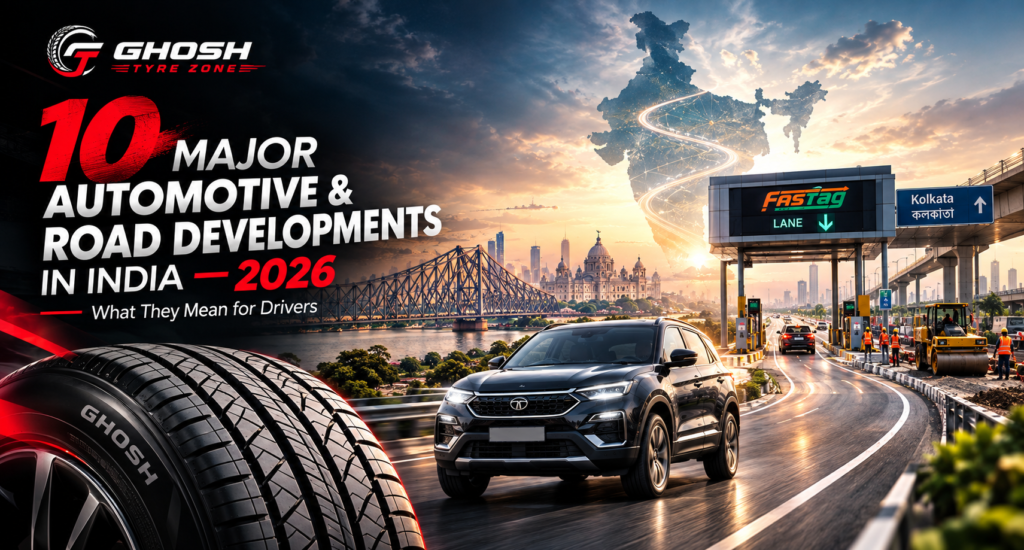
Road developments in India 2026 are changing the way motorists travel, maintain their vehicles and plan long-distance journeys. From rising tyre prices and natural rubber costs to highway expansion, FASTag developments and changing road conditions, India’s automotive and road landscape is evolving rapidly.
India’s automotive and road landscape is changing rapidly.
Tyre prices are facing pressure from rising natural rubber costs. Tyre manufacturers are continuing to invest in capacity. West Bengal is seeing major road infrastructure projects. National highways are moving toward more advanced tolling systems. And for drivers in Kolkata, changing road and weather conditions continue to make tyre safety more important than ever.
For vehicle owners, these developments are not just industry headlines.
They can directly influence vehicle running costs, tyre replacement decisions, highway travel, road safety and long-term vehicle maintenance.
At Ghosh Tyre Zone, we believe that being a responsible automotive partner means more than providing tyres and car-care services.
It means helping drivers understand what is happening in the automotive industry and how those changes may affect their everyday journeys.
Here are 10 important automotive and road developments every Indian driver should know about in 2026.
One of the biggest developments affecting the tyre industry in India is the sharp increase in the cost of natural rubber.
Natural rubber is a major raw material used in tyre manufacturing. Recent industry analysis reported natural rubber prices at approximately ₹275 per kg in June 2026, compared with around ₹220 per kg in FY2026.
Supply tightness and weather-related disruptions have contributed to the pressure on rubber prices.
And because natural rubber represents a significant portion of tyre manufacturers’ raw-material costs, changes in rubber prices can eventually affect the economics of tyre manufacturing.
When manufacturing costs rise, tyre manufacturers may revise prices to manage higher input costs.
However, this does not mean that every tyre or every tyre brand will automatically increase by the same amount.
The actual price of a tyre depends on several factors, including:
For drivers, the important takeaway is simple:
Don’t look at tyre price alone. Look at tyre value, safety, suitability and expected service life.
A tyre is one of the most important components connecting your vehicle to the road.
Several tyre manufacturers have announced or indicated price revisions during 2026 as the industry deals with higher raw-material costs.
Reports have also highlighted further price increases from manufacturers such as JK Tyre, with increases linked to rising input costs.
But what should a vehicle owner actually do?
Instead, start with a simple question:
Do your current tyres actually need replacement?
Inspect them for:
If your tyres are still healthy and within their recommended service condition, there may be no reason to replace them simply because prices are changing.
On the other hand, if your tyres are already approaching the end of their usable life, delaying replacement indefinitely may not be a sensible strategy either.
The right decision should be based on tyre condition, vehicle requirements, driving conditions and professional inspection.
At Ghosh Tyre Zone, our approach is to help customers choose according to their actual vehicle requirements rather than treating every customer with a one-size-fits-all recommendation.
There is another interesting development happening at the same time.
While tyre manufacturers are facing higher input costs and pressure on margins, India’s tyre industry continues to expand its manufacturing capacity.
Why?
Because the underlying demand for tyres remains significant.
India’s tyre market is supported by multiple segments, including:
Industry analysis indicates that the replacement market represents roughly half of overall tyre industry volumes, while OEM demand and exports each account for approximately a quarter.
For motorists, this reflects a broader change in India’s mobility ecosystem.
More vehicles, more kilometres driven and expanding road networks all create greater demand for tyres.
And that makes tyre maintenance increasingly important.
Because even as automotive technology becomes more sophisticated, one fundamental fact remains unchanged:
Your vehicle still depends on its tyres to maintain contact with the road.
West Bengal’s road infrastructure is also undergoing significant development.
The Centre has approved approximately ₹1,042.6 crore for six road infrastructure projects in West Bengal, covering more than 194 kilometres.
The projects include road stretches across areas including:
Better road infrastructure can influence how people travel.
Improved connectivity can support longer-distance journeys, smoother movement between regions and greater road accessibility.
But from a vehicle-maintenance perspective, changing road conditions also mean that drivers should pay attention to the condition of their vehicles.
Longer journeys and increased highway usage make routine checks increasingly valuable.
Before travelling, motorists should consider checking:
Tyre pressure → Tread → Alignment → Wheel balancing → Spare tyre → Battery condition
Because better roads do not eliminate the need for better vehicle preparation.
They can actually make reliable vehicle maintenance even more important as driving distances increase.
Another important development for West Bengal’s road network is the planned upgrade of a section of NH-327.
The National Highways Authority of India has initiated the bidding process for upgrading the approximately 31.025-kilometre Bagdogra–Panitanki–Kharibari–Galgalia section.
The proposed upgrade would take the road from two lanes with paved shoulders to four lanes, with the estimated project cost reported at approximately ₹863.30 crore excluding GST.
For drivers travelling through North Bengal, infrastructure improvements of this scale are significant.
But there is another side to increased highway travel:
Your vehicle has to be ready for it.
Highway driving places different demands on tyres compared with short city journeys.
Before a long-distance trip, consider checking:
A highway journey should never begin with the assumption that a tyre problem will simply be dealt with later.
Preparation is part of road safety.
The way Indian motorists pay tolls is also evolving.
India is moving toward more automated toll collection, with plans for barrier-free tolling using FASTag and AI-based cameras on several national highways.
The objective is to make toll collection more technology-driven and reduce dependence on traditional stopping points.
For motorists, this represents a broader shift in highway travel:
Less stopping. More automation. More technology.
At the same time, recent enforcement action has highlighted the importance of using legitimate toll-payment systems and remaining alert to unauthorised applications or payment mechanisms.
For drivers, the basic principle is straightforward:
As India’s highways become increasingly digital, responsible driving will involve not only maintaining the vehicle but also understanding the technology used on the road.
[NHAI — FASTag and Digital Tolling Information]
Link to the relevant official FASTag/NHAI source.
For people who spend a lot of time on highways, the FASTag Annual Pass has also become an important development.
The annual pass for eligible private vehicles was introduced at ₹3,000, with the fee subsequently revised to ₹3,075 for FY2026–27.
For the right type of traveller, an annual toll arrangement can be particularly relevant.
This includes:
However, whether an annual pass makes sense depends on an individual’s travel frequency, eligibility and usage pattern.
The broader trend is what matters:
Highway travel in India is becoming increasingly technology-enabled.
FASTag has already changed how millions of motorists approach toll payments, and the development of annual passes and barrier-free tolling indicates how India’s toll infrastructure continues to evolve.
[NHAI — FASTag Annual Pass Fee Revision for FY 2026–27]
Link to the relevant official government/NHAI information.
Tax policy can also influence the wider automotive ecosystem.
The 2025 GST restructuring affected multiple automobile categories and auto parts, with the government highlighting the potential impact on demand across the wider automotive supply chain.
For the automotive sector, this matters because a vehicle is not made up of one product.
It is an ecosystem involving:
Manufacturers → Component suppliers → Tyre companies → Battery manufacturers → Dealers → Service providers → Vehicle owners
Changes affecting one part of that ecosystem can have wider implications.
For consumers, however, it is important to avoid assuming that every GST change automatically means every tyre or automotive product has become cheaper.
The actual tax treatment depends on the specific product category and applicable rules.
The smarter approach is to look at the actual product price, specification, warranty, suitability and total value rather than making decisions based on headlines alone.
For vehicle owners, understanding the automotive ecosystem can make purchasing decisions more informed and less confusing.
For Kolkata drivers, this topic is particularly important.
Heavy rainfall and waterlogging can dramatically change driving conditions.
And when roads become wet, the condition of your tyres matters even more.
Your tyres need to maintain contact with the road while moving through water.
As tread wears down, the tyre’s ability to channel water away from the contact area can decrease.
This is where the risk of aquaplaning or hydroplaning becomes an important consideration.
1. Tread condition
Worn tyres can have reduced wet-road performance.
2. Tyre pressure
Incorrect pressure can affect handling and tyre performance.
3. Sidewall condition
Cuts, cracks and bulges should never be ignored.
4. Pothole impacts
A pothole can affect tyres, wheels and alignment.
5. Steering vibration
Persistent vibration can indicate a wheel, tyre or balancing issue that deserves inspection.
6. Uneven tyre wear
This can sometimes indicate alignment or other mechanical concerns.
7. Braking behaviour
Wet roads naturally require greater caution and appropriate following distance.
Kolkata’s roads can change dramatically between dry and wet conditions.
That means monsoon tyre safety should never be treated as a seasonal afterthought.
Put all these developments together and one larger trend becomes clear.
India’s driving environment is changing.
We are seeing:
Expanding highways.
Major road infrastructure investment.
Increasing vehicle usage.
Growing tyre demand.
Changing tyre costs.
Digital toll collection.
FASTag-based systems.
Greater highway connectivity.
And alongside all of this, vehicle owners are becoming increasingly conscious of safety, maintenance and operating costs.
The future of driving will not depend on just one technology.
It will be a combination of:
Better infrastructure + smarter vehicles + better maintenance + informed drivers.
For motorists, this means the fundamentals still matter.
A technologically advanced highway cannot compensate for a severely worn tyre.
A modern vehicle cannot eliminate the importance of correct tyre pressure.
A smoother toll system cannot replace responsible driving.
And a premium tyre cannot deliver its full potential if it is neglected.
The future of mobility may be smarter.
But responsible vehicle ownership will always remain essential.
The automotive industry is changing quickly, but the most important lessons for vehicle owners are surprisingly practical.
Don’t wait for a complete failure before inspecting your tyres.
Raw materials, supply conditions and manufacturing costs can all influence the final price.
Long-distance driving deserves more than a quick fuel stop.
Potholes, impacts and uneven wear can affect vehicle performance.
Wet roads, waterlogging and potholes require additional caution.
FASTag and digital toll systems are becoming an increasingly important part of Indian road travel.
The cheapest option is not necessarily the right option, and the most expensive option is not automatically the right option either.
The right tyre is the one that matches your vehicle, driving conditions and requirements.
As India’s road network and automotive industry evolve, one thing remains constant:
Tyres are still your vehicle’s connection to the road.
At Ghosh Tyre Zone, we provide more than tyre replacement.
Our services include:
We work with leading tyre and battery brands and focus on helping customers choose products and services according to their vehicle and driving requirements.
Because good automotive care is not simply about buying a product.
It is about understanding what your vehicle actually needs.
Rising natural rubber prices, supply constraints and other manufacturing and input costs are putting pressure on the tyre industry. Manufacturers may revise prices depending on their cost structure and market conditions.
Not necessarily. Tyre replacement should primarily depend on tyre condition, tread, damage, age, vehicle requirements and manufacturer recommendations. If your tyres are healthy, there may be no immediate need to replace them.
Check tyre pressure, tread condition, visible tyre damage, spare tyre condition, wheel alignment, wheel balancing and battery condition before a long journey.
Pothole impacts can affect wheel alignment. Incorrect alignment may contribute to uneven tyre wear, steering issues and reduced driving comfort.
Yes. Maintaining the manufacturer’s recommended tyre pressure is important for handling, tyre performance and overall road safety, particularly when driving in challenging wet-road conditions.
India is moving toward increasingly automated toll collection, including plans involving FASTag and AI-based camera systems on several national highways.
The FASTag Annual Pass is an option for eligible private vehicles, with the FY2026–27 fee reported at ₹3,075. Its usefulness depends on eligibility and how frequently the vehicle uses applicable highways.
India’s roads are changing.
India’s tyre industry is changing.
Highway technology is changing.
And the way we drive is changing with them.
For vehicle owners, staying informed can be just as valuable as staying on top of routine maintenance.
Whether you’re driving through Kolkata, travelling across West Bengal, heading toward North Bengal or taking a long highway journey, your vehicle needs to be ready for the road ahead.
Check your tyres.
Maintain your wheels.
Understand your vehicle.
Stay informed.
And when you need professional tyre and wheel-care support, Ghosh Tyre Zone is here to help.
Ghosh Tyre Zone is a trusted tyre and battery retailer in Kolkata, offering genuine products, expert installation, and professional wheel care services for all types of vehicles.
© 2026. Ghosh Tyre Zone. All Rights Reserved.